Escape Hybrid: My Crossover Project
4 November 2022 - Reading time: 7 minutes
When I needed a crossover with some off-road chops in the Kuga class, I started looking around. I was considering a Ford Maverick (2001-2003) or even a first-generation Ford Explorer, but since one of my friends already spends way too much time and money on Explorers, I thought I’d go with the Maverick instead.
Knowing that Radu once owned a Maverick with the classic Duratec-HE engine gave me some confidence and a good place to start my search.
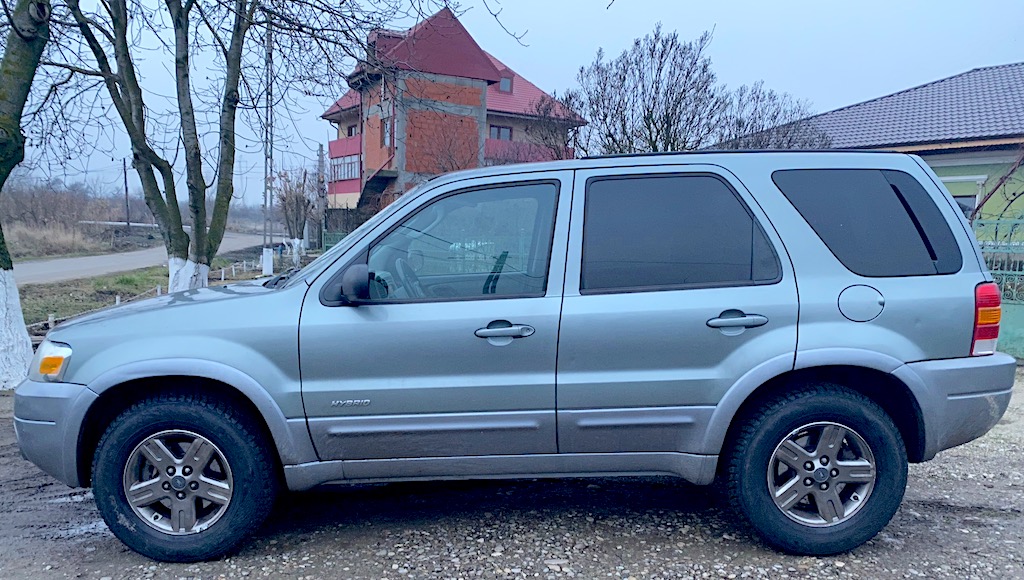
Not long after, I spotted one for sale in Brașov. The price was right, but the color... well, it was green. "Any color, as long as it’s blue," I told myself. What surprised me even more was that this 2005 Maverick was actually a Ford Escape Hybrid - something I hadn’t expected.
Ford started building the Escape Hybrid as early as 2005. It was the world’s first hybrid SUV, pioneering in many categories While it shares its platform with the Mazda Tribute, the hybrid system and electronics are uniquely Ford’s, making the Escape a robust and innovative vehicle for its time. It even served as a taxi in New York, San Francisco, and other major cities, with many examples surpassing 640,000 km without major issues.
So I went to Brașov, checked it out, and bought it.
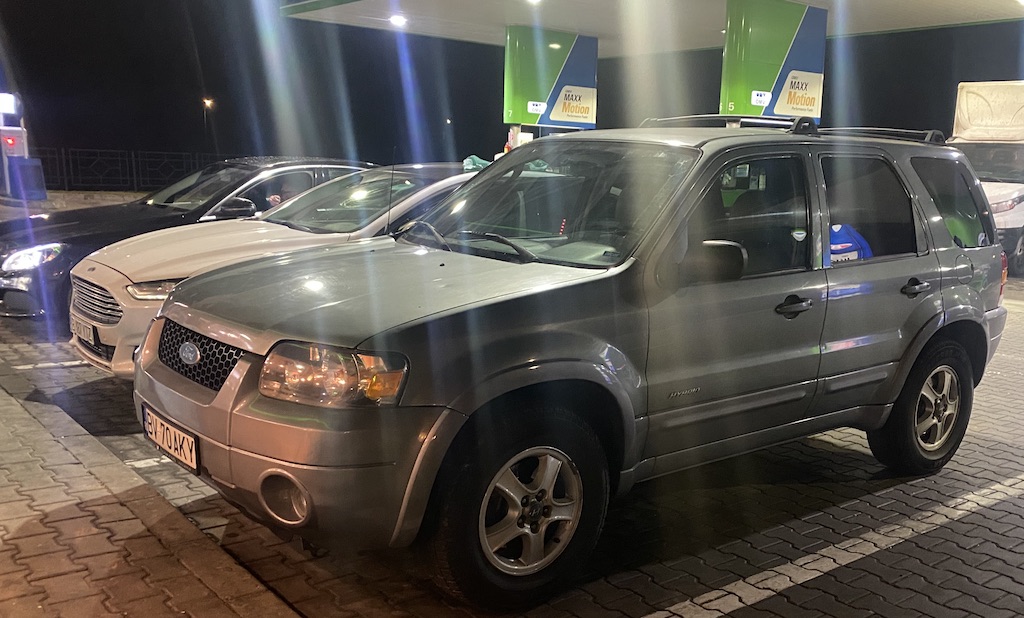
First photo
First Impressions
For its age, the car was in great shape:
- Battery showed a promising 87% capacity.
- A few minor fault codes popped up — the famous P1000 and a climate control actuator error.
- Bodywork was mostly solid, with some dents from ice falling off roofs.
- Remarkably rust-free — confirmed by a forum expert.
- The front end had been hit and poorly repaired.
- The previous owner had a small workshop and had taken care of minor repairs like lambda sensors, brake pads, and oil changes.
Price paid: €2,500. On the way home, I was impressed by how comfortable and composed it was for a crossover of that age — much better at absorbing bumps than I’d expected from a Maverick. Fuel consumption was reasonable, though it did gulp a bit during overtakes on country roads.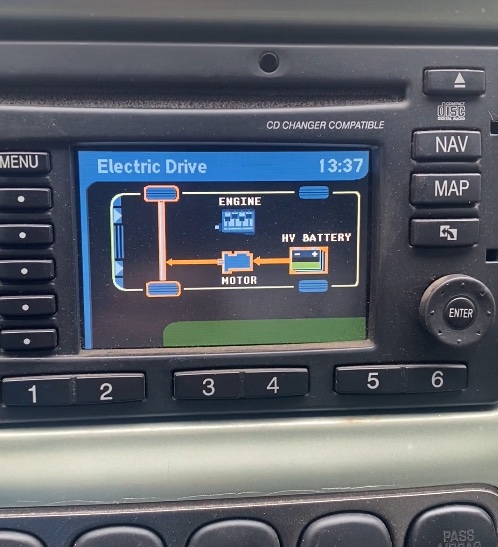
Original navigation shows hybrid information
What I Did to It
- Replaced the defective hybrid climate actuator. The replacement part was cheap and I suspect a Mondeo Mk3 actuator might even fit.
- Swapped out old tires (manufactured in 2014) for fresh rubber.
- Fixed the throttle flap, previously broken and glued badly. A Focus Mk2 2.0 petrol throttle body fit perfectly.
- Replaced the auxiliary water pump for cabin heating, along with the hybrid system water pump (they are part of a recall, so a failure point).
- Upgraded the interior: swapped original grey leather seats for black heated leather seats from a Maverick, with airbag system adapted accordingly. While at MS Tapiserie, I also restored the steering wheel and handbrake cover.
- The BCM has a very subtle fault with a door actuator so it got replaced - first tried a European unit then reverted to an original US spec one.
- Upgraded the dashboard cluster — swapped the faded white background for a Mercury Mariner cluster from the US. Huge improvement, programmed by DGAlexandru.
- Changed all consumables: brake discs, oil, filters, fluids. Replaced cracked coolant reservoir. Some parts came from Maverick models, others were US hybrid-specific - thankfully, rockauto.com was a huge help with very good prices and speedy shipping.
- Replaced the original navigation with a Sync3 unit from a Kuga and added a Focus Mk3 mic. Now the Escape supports CarPlay, multicolor ambient lighting controlled from the Sync3 screen, the original subwoofer, and a rear-view camera.
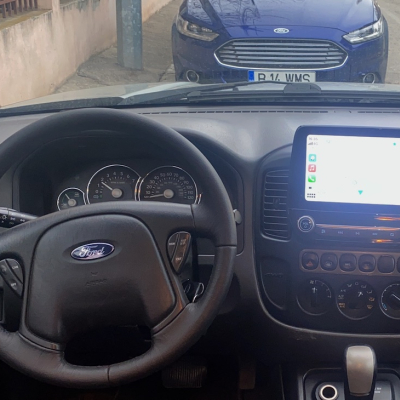
Sync3 and the Mariner instrument cluster
Driving Experience
The Escape quickly became my favorite city car. It’s soft, comfortable, and surprisingly economical around town - about 7.5 l/100 km - for a 2.3L naturally aspirated petrol, automatic, AWD crossover.
Its eCVT transmission, developed by Ford and made by Aisin, is unlike Toyota’s but shares the same smooth, step-less feel. It takes a bit of getting used to, but when driven as intended, it works really well.
Engine Rebuild
Things went sideways during an overtake when the engine decided to split its block in two places - apparently a piston need a sudden rush of air.
I sourced a 2.3L manual Maverick engine from 2002. It required minor differences in pistons and intake camshaft, but after thorough inspection, cleaning, and replacement of worn parts, it became practically a brand-new engine.
Surprisingly, the rebuilt motor runs much quieter and smoother than the original.
Original Equipment Highlights
- Light Tundra exterior color
- 2.3L Duratec-HE naturally aspirated Atkinson cycle engine, 133 HP
- 22 HP electric motor, 1.8 kWh battery
- Ford eCVT transmission
- AWD
- Cruise control
- Manual air conditioning
- Daytime running lights
- VNR-9000 navigation with 6-CD changer
- Premium 6-speaker audio + subwoofer
- 110V inverter
- Tinted windows
- Split-opening tailgate
- Central locking and power windows
- ISOFIX anchors
- Curtain airbags
- Regenerative ABS braking
- 16” alloy wheels
Build date: 02.02.2005, Kansas City
Search
About
This blog is my personal notebook for documenting what works, what doesn’t, and why — shared in case it helps someone else along the way.